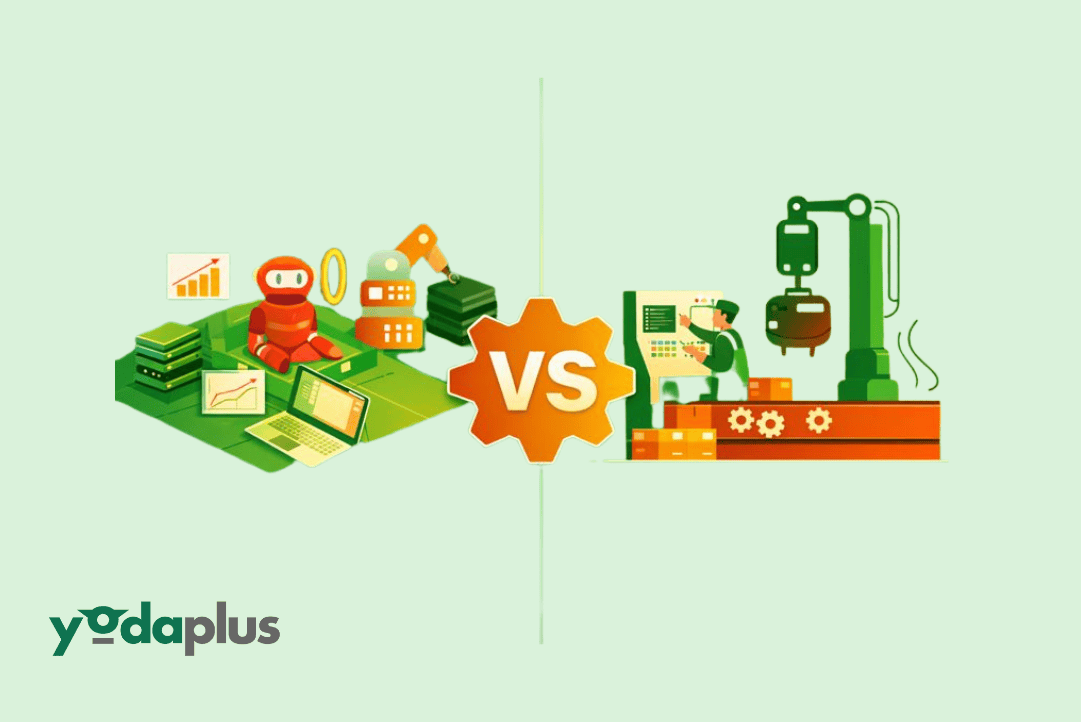
AI-First Automation vs Traditional Automation Models
December 17, 2025 By Yodaplus
What if automation could think, adapt, and improve on its own instead of waiting for rules to trigger actions? This question sits at the center of how businesses now look at Artificial Intelligence and automation. Many organizations still rely on traditional automation models, while others are moving toward AI-first automation powered by agentic AI, AI agents, and intelligent agents. Understanding the difference helps leaders choose the right path for the future of AI in business.
This blog explains both models in simple terms and shows why AI-first automation is becoming essential for modern enterprises.
What Is Traditional Automation?
Traditional automation focuses on predefined rules. Teams design workflows in advance and systems follow them exactly. If a condition occurs, the system performs a fixed action. This approach works well for stable and predictable tasks.
Examples include scheduled data transfers, rule-based alerts, and scripted workflows. These systems do not learn or adapt. They only execute what humans have already defined.
Traditional automation does not rely heavily on machine learning, deep learning, or neural networks. It does not use AI model training or AI-driven analytics. When conditions change, teams must manually update the rules.
This model helped businesses scale operations, but it struggles in complex environments where data changes frequently.
What Is AI-First Automation?
AI-first automation places Artificial Intelligence in business processes from the start. Instead of rules alone, systems rely on AI technology, AI models, and AI agents that can observe data, reason about outcomes, and act independently.
AI-first automation uses agentic AI, autonomous systems, and multi-agent systems. These systems include workflow agents that collaborate, share context, and adjust actions in real time. Many AI-first platforms use LLMs, generative AI, and knowledge-based systems to understand language, data, and intent.
AI-first automation supports AI-powered automation where systems improve through self-supervised learning, vector embeddings, semantic search, and prompt engineering. This allows automation to handle uncertainty instead of failing when rules break.
Key Differences Between the Two Models
Traditional automation depends on static logic. AI-first automation depends on intelligence and adaptability.
Traditional automation executes tasks. AI-first automation makes decisions using AI-driven analytics and data mining.
Traditional automation reacts to events. AI-first automation anticipates outcomes using AI risk management and predictive reasoning.
Traditional automation requires frequent human updates. AI-first automation improves through learning and feedback loops.
This shift changes automation from a tool into an active participant in operations.
Role of AI Agents and Agentic Frameworks
At the core of AI-first automation are AI agents. An AI agent observes data, decides on actions, and executes tasks toward a goal. Many teams ask what is an AI agent. It is software that combines reasoning, memory, and action.
Modern ai agent software uses agentic AI frameworks, ai agent frameworks, and ai agentic framework designs. These frameworks support autonomous agents, agent ai, and autonomous AI workflows.
Some platforms use Crew AI, AutoGen AI, and agentic AI platforms to coordinate multiple agents. These agentic AI solutions help systems plan tasks, delegate work, and resolve issues without constant human input.
Impact on AI Workflows and Operations
AI-first automation transforms AI workflows across departments. In finance, systems analyze reports using generative AI software and AI applications. In logistics, AI in logistics and AI in supply chain optimization help predict delays and optimize routes.
Conversational tools powered by Conversational AI assist teams in decision-making. AI systems also support reliable AI practices through monitoring, validation, and explainable AI methods.
Traditional automation cannot handle these dynamic workflows because it lacks reasoning and context.
Governance, Responsibility, and Risk
AI-first automation also introduces new responsibilities. Businesses must follow Responsible AI practices to ensure fairness, transparency, and accountability. AI risk management becomes critical when systems act autonomously.
Modern ai frameworks and agentic AI capabilities include safeguards such as audit logs, confidence scoring, and explainability layers. These features help teams trust automation outcomes and meet compliance needs.
Traditional automation offers control through simplicity, but it does not scale well when complexity increases.
Why Businesses Are Moving to AI-First Automation
Enterprises adopt AI-first automation to improve speed, accuracy, and resilience. Artificial intelligence services allow organizations to handle complex data, reduce manual effort, and support AI innovation.
AI-first automation supports the future of AI where systems adapt to change instead of breaking under it. With gen ai tools, gen ai use cases, and agentic ai models, businesses gain flexibility that traditional automation cannot deliver.
This shift is not about replacing humans. It is about enabling smarter systems that support better decisions.
Conclusion
Traditional automation laid the foundation for operational efficiency. AI-first automation builds on that foundation with intelligence, adaptability, and autonomy. By using AI agents, agentic AI frameworks, and AI-powered automation, organizations can manage complexity at scale.
For businesses exploring this transition, Yodaplus Automation Services helps design and implement AI-first automation strategies that align technology, governance, and business goals.
FAQs
What is the main advantage of AI-first automation?
It adapts to change using learning and reasoning instead of fixed rules.
Is traditional automation still useful?
Yes, it works well for stable and repetitive tasks with low variability.
What is an AI agent in automation?
An AI agent is software that observes data, decides actions, and executes tasks autonomously.
Does AI-first automation increase risk?
It introduces new risks, but strong AI risk management and responsible AI practices reduce them.