
Custom ERP vs SaaS ERP: Which is Better for Your Business?
March 19, 2025 By Yodaplus
Enterprise Resource Planning (ERP) systems have become the foundation of modern business operations, helping organizations manage finance, procurement, inventory, manufacturing, sales, human resources, and supply chain activities from a single platform. As businesses continue their digital transformation journeys, one of the most important decisions they face is whether to implement a custom ERP solution or adopt a Software-as-a-Service (SaaS) ERP platform.
Both approaches offer significant benefits, but they are designed for different business needs. SaaS ERP provides a standardized, cloud-based solution that can be deployed quickly with lower upfront investment. Custom ERP, on the other hand, is designed around an organization’s unique business processes, offering greater flexibility, deeper integration, and higher levels of customization.
Choosing between the two requires more than comparing costs. Businesses must evaluate operational complexity, scalability, security, compliance requirements, integration needs, and long-term growth plans before selecting the right ERP strategy.
What Is a SaaS ERP?
A SaaS ERP is a cloud-based enterprise resource planning solution delivered through a subscription model.
The software is hosted by the vendor and accessed through a web browser without requiring businesses to maintain their own infrastructure.
Most SaaS ERP platforms include modules for:
- Finance
- Procurement
- Inventory
- Sales
- Customer relationship management
- Human resources
- Manufacturing
- Reporting
Since the provider manages infrastructure, maintenance, and software updates, organizations can begin using the system relatively quickly.
What Is a Custom ERP?
A custom ERP is an enterprise resource planning system developed specifically for an organization’s operational requirements.
Instead of adapting business processes to fit standard software, the ERP is designed around existing workflows, approval structures, reporting requirements, and operational goals.
A custom ERP can include functionality such as:
- Industry-specific workflows
- Custom approval processes
- Specialized reporting
- ERP integrations
- Role-based dashboards
- Business-specific automation
- AI-powered workflows
This approach gives organizations greater control over how the system supports day-to-day operations.
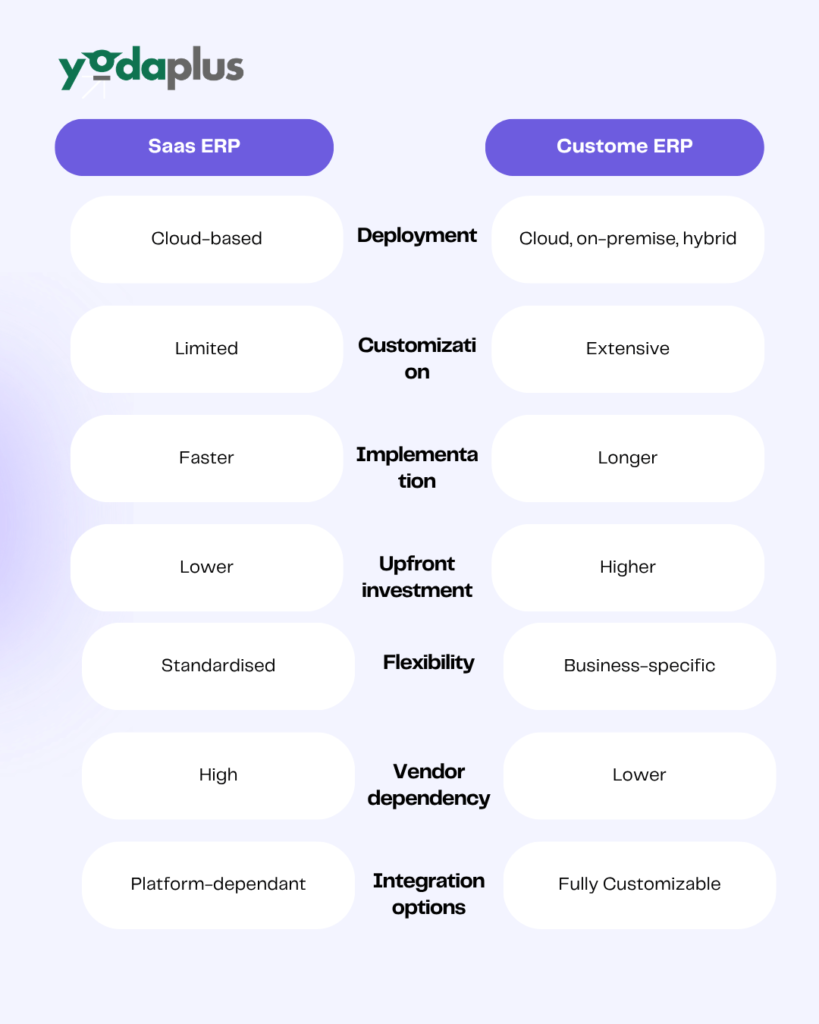
Comparing Custom ERP and SaaS ERP
Although both solutions perform similar functions, they differ significantly in how they are implemented and managed.
When SaaS ERP Is the Better Choice
SaaS ERP is often a good fit for organizations seeking rapid deployment and standardized business processes.
It is commonly chosen by:
- Small businesses
- Growing startups
- Companies with standard workflows
- Organizations with limited IT resources
- Businesses looking for predictable subscription costs
Because infrastructure and updates are managed by the software provider, internal IT teams spend less time maintaining the platform.
This allows businesses to focus more on operations than technology management.
When Custom ERP Is the Better Choice
Organizations with complex business models often benefit more from a custom ERP solution.
Custom ERP is well suited for businesses that require:
- Specialized workflows
- Complex approval processes
- Multiple business entities
- Industry-specific functionality
- Advanced reporting
- Deep integration with existing systems
- High levels of automation
Instead of forcing operations to fit standard software, custom ERP adapts to the business.
This provides greater flexibility as organizations grow and operational requirements evolve.
Scalability and Long-Term Growth
Business requirements rarely remain the same.
Organizations expand into new markets, launch new products, acquire businesses, and introduce new operational processes.
SaaS ERP platforms generally scale well by allowing businesses to add users or standard modules.
Custom ERP offers a different type of scalability.
Organizations can introduce entirely new workflows, business logic, AI capabilities, and integrations as operational requirements evolve.
This flexibility is particularly valuable for enterprises with unique or rapidly changing business models.
Integration Capabilities
An ERP system delivers the greatest value when it connects seamlessly with other business applications.
Most organizations rely on multiple systems for finance, customer relationship management, procurement, ecommerce, payroll, logistics, and business intelligence.
SaaS ERP platforms usually offer predefined integrations with commonly used applications. While these integrations simplify implementation, they may be limited when organizations require specialized workflows or custom business logic.
Custom ERP solutions provide greater flexibility by allowing businesses to integrate with virtually any internal or third-party system.
This makes it easier to connect:
- CRM platforms
- Procurement systems
- Warehouse Management Systems (WMS)
- Manufacturing software
- Ecommerce platforms
- Banking applications
- Business intelligence tools
- AI and automation platforms
For businesses with complex technology environments, custom integration often improves operational efficiency and reduces manual data entry.
Security and Compliance
Security is a critical consideration when selecting an ERP system.
Organizations handle sensitive financial information, employee records, customer data, supplier contracts, and operational information through their ERP platforms.
SaaS ERP providers typically offer enterprise-grade security features, including:
- Data encryption
- Multi-factor authentication
- Automatic backups
- Disaster recovery
- Regular security updates
Custom ERP solutions allow organizations to implement security controls that align with their specific business and regulatory requirements.
Businesses operating in highly regulated industries often prefer custom ERP because they have greater control over:
- Data storage
- User access
- Compliance policies
- Audit trails
- Industry-specific security requirements
The right choice depends on an organization’s governance, regulatory obligations, and internal security policies.
Artificial Intelligence Is Changing ERP Systems
Artificial intelligence is transforming ERP from a system that records business activities into one that helps organizations make better decisions.
Modern ERP platforms increasingly use AI to:
- Forecast demand
- Optimize inventory
- Detect financial anomalies
- Automate invoice processing
- Predict cash flow
- Recommend procurement decisions
- Generate business insights
- Support operational planning
Rather than replacing ERP, AI enhances its ability to identify trends, reduce manual work, and improve decision-making.
Businesses adopting ERP today should evaluate how AI capabilities will support future operational requirements.
Total Cost of Ownership
Implementation costs are only one part of an ERP investment.
Organizations should also consider the long-term cost of ownership.
With SaaS ERP, businesses typically pay recurring subscription fees while the vendor manages maintenance, updates, and infrastructure.
This results in lower upfront investment and predictable operating costs.
Custom ERP generally requires a larger initial investment because the platform is designed specifically for the organization’s needs.
However, over time, businesses gain greater control over functionality, integrations, and future enhancements without being limited by vendor roadmaps or standard product capabilities.
Evaluating long-term business value is often more important than comparing initial implementation costs alone.
Which ERP Should You Choose?
There is no universal answer.
The right ERP depends on business size, operational complexity, industry requirements, and long-term strategy.
A SaaS ERP may be the right choice if your organization:
- Needs rapid implementation
- Has standardized business processes
- Prefers subscription-based pricing
- Has limited internal IT resources
A custom ERP may be the better option if your business:
- Requires specialized workflows
- Operates across multiple business entities
- Needs deep system integration
- Has industry-specific compliance requirements
- Plans to automate complex business processes
- Wants greater flexibility as the business grows
Many organizations also adopt a hybrid approach, combining commercial ERP platforms with custom modules and intelligent automation to address unique operational needs.
The Future of Enterprise Resource Planning
ERP platforms are evolving beyond transaction management.
Future ERP systems will combine:
- Artificial intelligence
- Agentic AI
- Intelligent workflow automation
- Predictive analytics
- Cloud-native architecture
- Real-time reporting
- Low-code development
- Enterprise-wide integration
These capabilities will enable ERP systems to support decision-making rather than simply recording business activities.
Organizations that invest in intelligent ERP platforms will be better positioned to improve operational efficiency, respond to market changes, and scale with confidence.
Conclusion
Both custom ERP and SaaS ERP provide significant benefits, but they serve different business needs. SaaS ERP offers faster deployment, lower upfront costs, and standardized functionality, making it well suited for organizations with common business processes. Custom ERP provides greater flexibility, deeper integration, and the ability to support unique operational requirements, making it a strong choice for businesses with complex workflows or industry-specific needs.
The best ERP strategy is one that aligns with your organization’s long-term goals rather than simply addressing immediate operational requirements. As businesses continue adopting artificial intelligence, automation, and advanced analytics, ERP platforms will become increasingly intelligent, connected, and capable of supporting enterprise-wide decision-making.
Yodaplus Enterprise Solutions helps organizations design, develop, and modernize ERP platforms through custom ERP development, enterprise application integration, AI-powered workflow automation, cloud migration, system modernization, and intelligent business process automation. By combining deep technology expertise with enterprise consulting, Yodaplus enables businesses to build scalable, secure, and future-ready ERP solutions tailored to their operational needs.
FAQs
A SaaS ERP is a cloud-based solution with standardized features delivered through a subscription model, while a custom ERP is designed specifically for an organization’s unique business processes and operational requirements.
SaaS ERP is ideal for small and mid-sized businesses, startups, and organizations with standardized workflows that want faster implementation and predictable subscription costs.
A custom ERP is better suited for businesses with complex workflows, multiple business entities, industry-specific requirements, extensive integration needs, or advanced automation goals.
Yes. AI enhances ERP systems by automating routine tasks, forecasting demand, detecting anomalies, improving financial planning, optimizing inventory, and providing real-time business insights.
Yodaplus Enterprise Solutions provides custom ERP development, enterprise integration, AI-powered automation, cloud migration, workflow optimization, and system modernization to help organizations build ERP platforms that support long-term business growth and operational efficiency.