
What Are Open Source Large Language Models? A Simple Guide
December 17, 2025 By Yodaplus
Open source large language models are becoming a key building block in modern Artificial Intelligence systems. As businesses adopt AI for automation, analytics, and decision support, many teams want models that are flexible, transparent, and easy to adapt. Open source large language models meet these needs by combining powerful language understanding with open development practices.
This guide explains open source large language models in plain English and shows how they fit into real-world AI systems.
What Are Large Language Models?
Large language models are AI models that understand and generate human language. They rely on machine learning, deep learning, and neural networks to learn patterns from large text datasets.
During AI model training, these models use self-supervised learning to predict words and meanings based on context. Over time, they become capable of summarizing content, answering questions, generating text, and supporting reasoning tasks.
Large language models are the foundation behind many AI applications such as chat interfaces, document analysis, and conversational AI systems.
What Makes a Language Model Open Source?
Open source means the model code, architecture, or weights are available for public use. Developers and businesses can study how the model works, customize it, and deploy it in their own environments.
In AI, open source supports transparency and trust. Teams can inspect model behavior, apply explainable AI methods, and improve AI risk management. Open access also encourages collaboration, which drives faster AI innovation.
Open source large language models combine advanced AI technology with shared ownership and flexibility.
How Open Source Large Language Models Work
Open source large language models use the same core techniques as proprietary models. They are built using transformer-based AI systems that process text through vector embeddings and semantic relationships.
These models can be fine-tuned for specific tasks such as document search, summarization, or conversational workflows. Many teams integrate them with semantic search, knowledge-based systems, and AI-driven analytics.
Open source ai frameworks help deploy these models across business systems, making them practical for Artificial Intelligence in business use cases.
How an Open Source LLM Is Used
A typical setup looks like this:
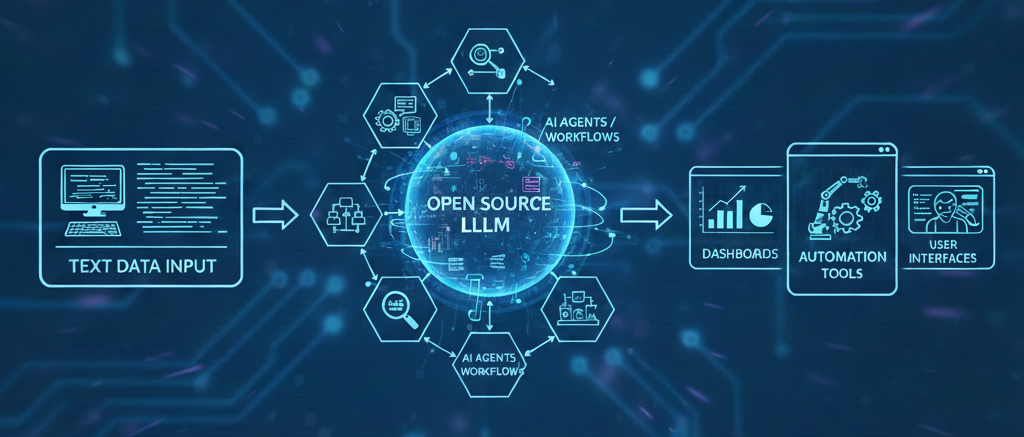
This structure allows teams to plug language intelligence into existing systems without redesigning everything.
Why Businesses Choose Open Source LLMs
Open source large language models give businesses more control. Organizations can host models on their own infrastructure, manage sensitive data, and meet compliance requirements.
They also reduce dependency on a single vendor. Teams can experiment with prompt engineering, customize workflows, and adapt models to industry-specific language.
For companies focused on reliable AI and responsible AI practices, open source models make governance easier and more transparent.
Role of Open Source LLMs in AI Agents
Open source large language models play a major role in agentic AI. Many AI agents rely on LLMs for reasoning, planning, and communication.
An AI agent observes inputs, decides actions, and executes tasks. Open source LLMs allow teams to build ai agent software that fits their workflows and data policies.
These agents often work inside multi-agent systems and autonomous systems. Agentic AI frameworks and ai agent frameworks use open models to support workflow agents and autonomous agents that adapt over time.
Use Cases Across Industries
Open source LLMs support many gen ai use cases. In IT services, they assist with intelligent automation and system analysis. In operations, they help process logs, documents, and unstructured text.
In analytics, they enable AI-driven analytics through natural language queries. In logistics and planning, they support optimization and decision-making. When combined with AI-powered automation, they help reduce manual work and improve consistency.
Because they are open, the same models can be reused across teams and departments.
Governance, Risk, and Reliability
Using open source models still requires strong controls. Teams must manage AI risk management, monitor outputs, and validate performance.
Open access makes it easier to apply explainable AI techniques and track how decisions are made. This supports reliable AI systems that teams can trust in production environments.
With proper oversight, open source LLMs become a safe and scalable part of enterprise AI systems.
Open Source LLMs and the Future of AI
The future of AI points toward openness and interoperability. Open source large language models support shared progress and faster learning across industries.
They enable agentic AI solutions, agentic AI platforms, and scalable AI workflows. As gen ai tools evolve, open models will continue to play a central role in enterprise adoption.
Open source does not replace proprietary models. It provides choice, flexibility, and long-term control.
Conclusion
Open source large language models make advanced AI more accessible and transparent. By combining Artificial Intelligence, LLMs, and open ecosystems, businesses can build systems that adapt and scale.
For organizations looking to apply these models in real workflows, Yodaplus Automation Services supports the design and deployment of open source AI systems, agentic AI frameworks, and enterprise-ready automation.
FAQs
What is an open source large language model?
It is an LLM whose code or weights are openly available for use and customization.
Are open source LLMs suitable for enterprises?
Yes, with proper governance and AI risk management, they work well in enterprise environments.
Can open source LLMs be used with AI agents?
Yes, they are widely used in AI agents and agentic AI frameworks.
Do open source LLMs require advanced expertise?
Basic deployments are simple, while advanced customization benefits from AI expertise.