
Skills-Based Routing vs Rule-Based Routing in BFSI
April 7, 2026 By Yodaplus
Skills-based routing and rule-based routing are two core approaches used to assign tasks in financial systems, each with its own strengths and limitations depending on complexity and scale.
Many financial institutions report that inefficient task assignment can impact up to 20–30% of workflow efficiency. So how should organizations choose between these routing models?
Why Routing Strategy Matters
Routing determines how tasks move through workflows. In financial systems, this directly affects speed, accuracy, and risk management.
In environments driven by financial services automation, poor routing leads to delays, misallocation of resources, and operational inefficiencies.
Choosing the right routing model is not just a technical decision. It is a strategic one.
What Is Rule-Based Routing
Rule-based routing assigns tasks using predefined conditions. These rules are simple and easy to implement.
Examples:
- If transaction value is above a threshold, route to senior team
- If risk score is low, process automatically
- If document type matches a category, assign to a specific queue
This model works well in structured environments where decision logic is stable.
In systems using automation in financial services, rule-based routing provides predictability and control.
Advantages of Rule-Based Routing
- Easy to design and implement
- High transparency in decision logic
- Suitable for repetitive tasks
- Low computational complexity
Limitations of Rule-Based Routing
- Cannot adapt to changing conditions
- Requires frequent manual updates
- Struggles with complex scenarios
- Limited flexibility
Even with automation, rule-based systems can become rigid over time.
What Is Skills-Based Routing
Skills-based routing assigns tasks based on the capabilities of available resources. Instead of fixed rules, it considers who is best suited to handle a task.
Factors include:
- Expertise level
- Experience with specific cases
- Current workload
- Performance history
This model is widely used in systems powered by ai in banking, where dynamic decision-making is required.
Advantages of Skills-Based Routing
- Better task-resource matching
- Improved efficiency for complex tasks
- Reduced error rates
- Balanced workload distribution
This approach aligns well with intelligent automation in banking, where systems adapt to real-time conditions.
Limitations of Skills-Based Routing
- More complex to implement
- Requires accurate data on skills and performance
- Needs continuous updates
- Can be harder to audit
Without proper governance, skills-based routing can become difficult to manage.
Key Differences Between the Two Models
The difference between these models lies in how decisions are made.
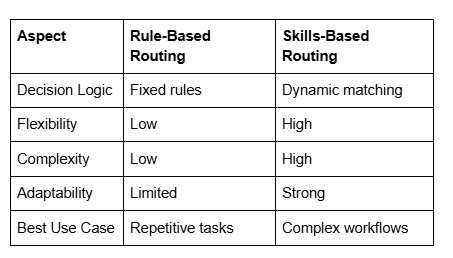
In financial services automation, both models play important roles.
When to Use Rule-Based Routing
Rule-based routing is effective when:
- Processes are predictable
- Decision logic is stable
- Tasks are repetitive
- Compliance requires strict control
For example, low-risk transactions can be processed using predefined rules without human intervention.
This ensures efficiency in automation in financial services.
When to Use Skills-Based Routing
Skills-based routing is better suited for:
- Complex decision-making
- High-risk transactions
- Exception handling
- Customer-specific scenarios
For instance, fraud investigations or credit assessments often require specialized expertise.
In such cases, artificial intelligence in banking can help identify the best resource for each task.
Designing a Hybrid Routing Model
Most financial institutions benefit from combining both approaches.
A hybrid model can follow this structure:
- Use rule-based routing for initial classification
- Apply skills-based routing for complex cases
- Continuously monitor outcomes
- Refine routing logic based on performance
This approach combines the simplicity of rules with the flexibility of skills.
It is a common strategy in intelligent automation in banking systems.
Algorithm for Hybrid Routing
Here is a simple logical flow:
- Capture incoming task
- Apply rule-based classification
- Determine task complexity
- If low complexity, route using rules
- If high complexity, evaluate resource skills
- Assign task to best-fit resource
- Monitor performance
- Adjust routing logic based on feedback
This ensures efficient and scalable routing.
Role of AI in Routing Decisions
With the growth of ai in banking, routing systems are becoming more advanced.
AI can:
- Analyze task characteristics
- Predict complexity levels
- Recommend optimal resource allocation
In advanced systems, artificial intelligence in banking continuously improves routing decisions based on outcomes.
This enhances both rule-based and skills-based approaches.
Common Challenges in Implementation
Organizations may face challenges when implementing routing models:
- Lack of accurate data on resource skills
- Over-reliance on static rules
- Difficulty in integrating systems
- Resistance to adopting new processes
These challenges must be addressed to make automation effective.
Benefits of Choosing the Right Model
When routing is designed correctly, organizations gain:
- Faster processing times
- Improved accuracy
- Better resource utilization
- Reduced operational risk
- Enhanced customer experience
These benefits strengthen financial services automation.
Conclusion
Skills-based routing and rule-based routing are not competing approaches. They are complementary tools that serve different purposes in financial workflows.
Rule-based routing provides structure and predictability. Skills-based routing adds flexibility and intelligence. Together, they enable efficient and scalable task assignment.
As financial institutions expand their use of automation in financial services, adopting a hybrid routing model becomes essential.
This is where Yodaplus Financial Workflow Automation helps organizations design routing frameworks that combine rules and skills effectively, enabling smarter, faster, and more reliable financial operations.