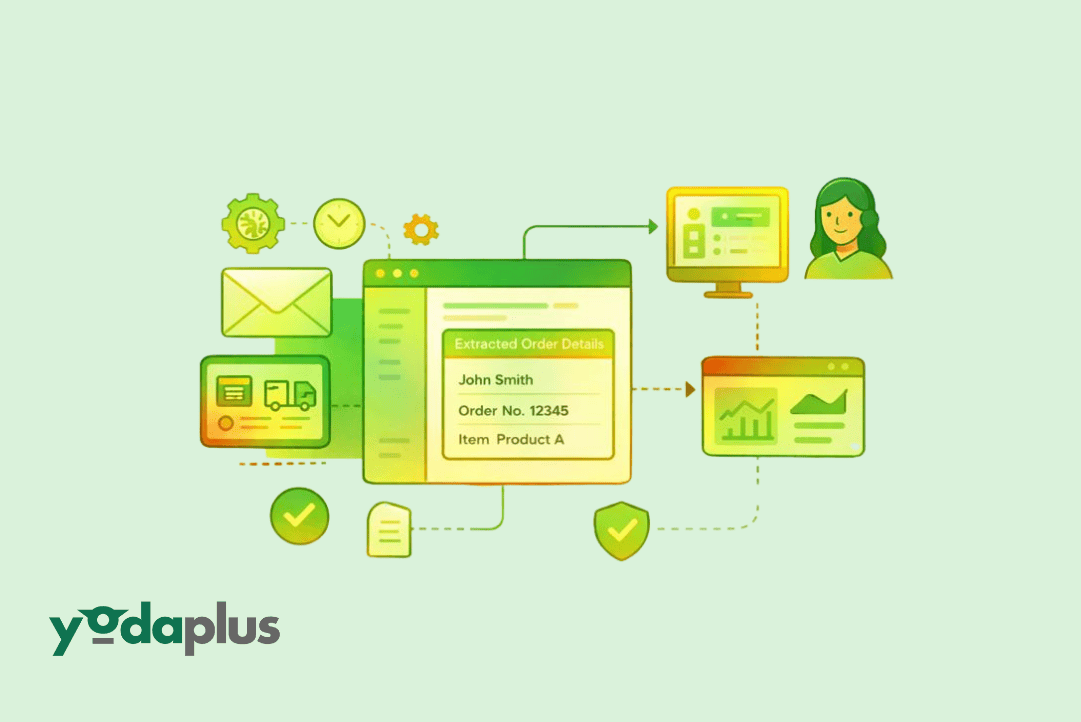
How AI Reliably Extracts Order Data From Email and CRM
January 16, 2026 By Yodaplus
Orders arrive in many forms. Some come as structured CRM entries. Others arrive as emails with PDFs, spreadsheets, or plain text. Manual extraction fails because formats vary and details change often. AI solves this by treating order data as information to be understood, not just text to be copied. In order to cash automation, reliable extraction depends on intelligent document processing, validation logic, and workflow awareness. This blog explains how AI makes that extraction dependable across channels.
Why emails and CRMs are difficult sources
Emails are unstructured by nature. One customer sends a clean PDF. Another sends a scanned image. A third writes quantities in the email body. CRMs appear structured but still contain inconsistencies. Sales teams override fields, attach documents, or leave notes incomplete. In manufacturing automation and retail automation, these variations cause downstream errors. Reliable order to cash automation requires AI that can adapt to format changes without breaking.
Role of intelligent document processing
Intelligent document processing is the foundation. It combines OCR for invoices and orders with layout understanding and field classification. OCR captures raw text. Intelligent document processing adds meaning. It identifies order numbers, product codes, quantities, prices, and delivery terms even when placement changes. This approach allows AI to extract order data consistently from emails and attachments. Data extraction automation improves accuracy before data reaches ERP systems.
How AI handles email based orders
For email orders, AI reads both the email body and attachments. It identifies intent by looking for order signals such as quantities, product references, and delivery requests. Intelligent document processing classifies attachments and extracts line items. AI then links email content with document data to build a complete order. This reduces reliance on fixed templates. In order to cash process automation, this flexibility prevents failures when suppliers or customers change formats.
Extracting order data from CRMs
CRMs provide structured fields, but reliability issues still exist. AI validates CRM data instead of trusting it blindly. It checks customer details, pricing, and quantities against historical patterns and ERP rules. When CRM orders include attachments or notes, AI extracts supporting data and reconciles it with structured fields. This ensures CRM orders meet the same standards as email orders before entering order to cash automation.
Validation against ERP rules
Extraction alone is not enough. Reliability comes from validation. After extraction, AI compares order data with ERP master data. It verifies customer records, pricing agreements, tax rules, and delivery terms. Missing or inconsistent fields trigger early exceptions. This prevents bad orders from entering manufacturing process automation or retail fulfillment workflows. Validation is where AI protects the system from downstream rework.
Role of agentic AI workflows in reliability
Agentic AI workflows manage decisions around extracted data. An agent evaluates confidence levels for each extracted field. High confidence orders move forward automatically. Low confidence orders trigger targeted reviews. Over time, agentic ai workflows learn common patterns for each customer and channel. This learning reduces false exceptions and improves accuracy. This adaptive behavior is critical for scaling order to cash automation.
Handling variations and changes over time
Order formats change frequently. Customers update templates. Sales teams add new fields. Rule based systems fail here. AI systems trained on patterns adapt more easily. Intelligent document processing models retrain on new samples. Agentic AI workflows adjust confidence thresholds based on outcomes. This allows extraction to remain reliable without constant manual updates. Manufacturing automation and retail automation both benefit from this resilience.
Exception handling as part of extraction
Not all orders can extract cleanly. Reliable systems expect this. Instead of stopping, AI flags specific fields that need review. It routes issues to the right team based on context. This targeted exception handling keeps order to cash automation moving. It also prevents finance and operations teams from reviewing entire orders manually.
Impact on forecasting and downstream processes
Clean extracted order data improves more than processing speed. It improves data quality across systems. Accurate orders feed better sales forecasting and ai sales forecasting models. Procurement automation responds faster to real demand. Procure to pay automation benefits from clearer purchase signals. Accounts payable automation aligns better with expected costs. Reliable extraction strengthens the entire financial cycle.
Manufacturing and retail perspectives
In manufacturing automation, orders drive production planning. Poor extraction leads to rework and delays. AI based extraction ensures production teams receive trustworthy data. In retail automation, order volumes are high and speed matters. Retail automation ai relies on fast and accurate extraction to prevent backlogs. Both environments depend on consistent order data.
FAQs
Is OCR enough to extract order data reliably?
No. OCR captures text, but intelligent document processing understands structure and meaning.
Do CRMs eliminate the need for extraction?
No. CRM data still requires validation and reconciliation.
Can AI handle handwritten or scanned orders?
Yes, with lower confidence scores and targeted review.
How does this reduce manual work?
AI extracts and validates most orders automatically, leaving only true exceptions.
Final thoughts
AI extracts order data from emails and CRMs reliably by combining intelligent document processing, validation logic, and agentic AI workflows. With Yodaplus Automation Services, reliability comes from understanding context, not enforcing rigid templates. When extraction feeds clean data into ERP systems, order to cash automation becomes scalable and predictable. This approach supports manufacturing automation, retail automation, and connected financial operations. Reliable extraction is not about perfect accuracy. It is about consistent outcomes at scale.